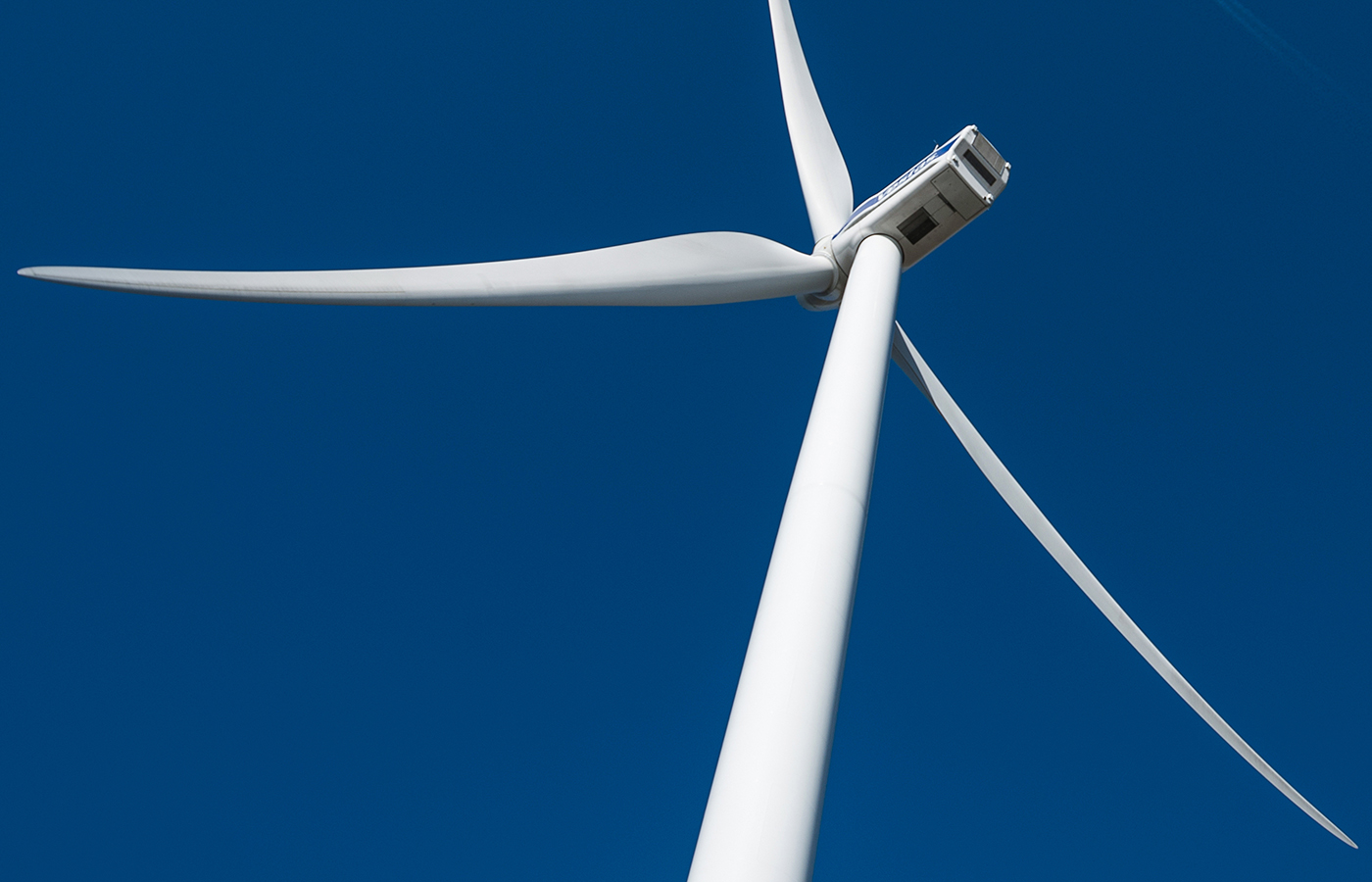
Wind turbines are getting bigger and bigger. As a result, their components are subjected to ever-increasing loads, such as sudden gusts of wind and other turbulence. A team from the University of Oldenburg, together with partners from ICM – Institut Chemnitzer Maschinen- und Anlagenbau e.V. and the manufacturer Nordex, has now made important progress in describing these loads. In three articles published in the journal Wind Energy Science, the researchers led by turbulence expert Prof. Dr. Joachim Peinke from the Center for Wind Energy Research – Forwind describe a new concept that can be used to describe the mechanical forces on rotors better than previous standard models. “We are thus providing a potential tool for load assessments that can be used in the planning and design of wind turbines,” explains Peinke.
The rotor surface of an offshore wind turbine – the circular area that is swept by the rotor blades as they rotate – can now reach a diameter of more than 200 meters. At full load, such wind turbines generate an output of 20 megawatts – enough to supply 200,000 people with electricity. A particular challenge of the growth in size is that the turbines and their parts are constantly bending due to changing wind forces. These deformations cause the material to fatigue, which can lead to cracks or even fractures. “Until now, manufacturers have assumed for the sake of simplicity that gusts always hit the entire rotor surface evenly,” explains co-author Jörg Schwarte from Nordex. This assumption was sufficient for smaller turbines, but turbulent wind conditions play a greater role in wear for larger wind turbines. The new finding of the current collaborative study: sudden gusts of wind concentrated in small spatial areas are the decisive factor for material fatigue. In order to better adapt wind turbines to these loads, manufacturers therefore need a better mathematical description of the wind and its fluctuations over the rotor.
The team has now proposed a new measure for the effect of local gusts in three publications. The researchers developed a method to calculate the force on the rotor blades from the current wind conditions – experts refer to this as the wind field. They describe the load using a simple variable, which they call the center of pressure. “If the wind flow is uniform, the center of pressure is exactly in the middle of the rotor surface,” explains Peinke. However, if a gust of wind only affects part of the rotor surface, the center of pressure moves away from the center, causing the rotor blades to bend more and creating a torque on the nacelle of the turbine.
In order to develop the new load concept, the team used measurement data from modern turbines as well as detailed wind data from the 1980s, which had been recorded by several measuring masts as part of the GROWIAN project in Schleswig-Holstein. Dr. Jan Friedrich from the University of Oldenburg used this data to reconstruct wind fields above the rotor surface. The researchers used this to carry out so-called aeroelastic simulations, in which they calculated the wind flows and the bending wind turbines simultaneously.
The researchers then used complex flow simulations to prove that the design of the center of pressure describes the actual loads on the system well. “Although we were able to use the university’s high-performance computing cluster for this, the simulations for large systems can only be calculated in detail for a few minutes,” reports Marcel Bock, PhD student at the University of Oldenburg and first author of one of the specialist articles. In the third paper, a team led by Peinke and doctoral student Daniela Moreno created a stochastic model for the center of pressure, which simplifies the calculations and could enable manufacturers to carry out long-term simulations over several years in the future.
“Particularly strong bending occurs when the center of pressure reaches the outer area of the rotor surface,” explains Dr. Carsten Schubert from the ICM. The team reports that such violent events are not detected by the control systems of current turbines and are therefore not mitigated. This could now be possible thanks to the new studies. The results are also helpful for the design of wind turbines, reports Oldenburg wind researcher Dr. Matthias Wächter: “The manufacturers estimate all expected bending of the material during a 20-year service life and plan the material and material thickness of the components accordingly.” Until now, there have been major uncertainties in this process – mainly because the wind conditions could not be calculated with sufficient accuracy. “Reducing these uncertainties would be a great benefit, as premature component failures are a major cost factor in wind energy,” says co-author Gritt Pokriefke from Nordex. New, detailed wind measurements are currently being carried out at the WiValdi research wind farm on the Elbe, in which ForWind is involved.
The publications are largely the result of the PASTA project (Precise design methods for complex coupled vibration systems of modern wind turbines in turbulent excitation), which was funded by the Federal Ministry of Economics over a period of three and a half years and coordinated by Nordex.
Original publications:
Carsten Schubert et al: “Introduction of the Virtual Center of Wind Pressure for correlating large-scale turbulent structures and wind turbine loads”, Wind Energy Science, doi.org/10.5194/wes-11-1267-2026
Daniela Moreno et al: “From the center of wind pressure to loads on the wind turbine: a stochastic approach for the reconstruction of load signals”, Wind Energy Science 10, 2729-2754, 2025, doi.org/10.5194/wes-10-2729-2025
Marcel Bock et al: “Comparison of different simulation methods regarding loads, considering the center of wind pressure”, Wind Energy Science, 11, 103-126, 2026, doi.org/10.5194/wes-11-103-2026
Original press release (Carl von Ossietzky University Oldenburg): https://uol.de/pressemitteilungen/2026/038